Report 2023

For the National Assessment and Examinations Center each new year brings forth new challenges.

In the past years, particularly during the COVID 19 outbreak, the NAEC team faced significant challenges, yet the pandemic also provided a unique opportunity to build resilience. Remarkably, 2023 marked a record number of university applicants.

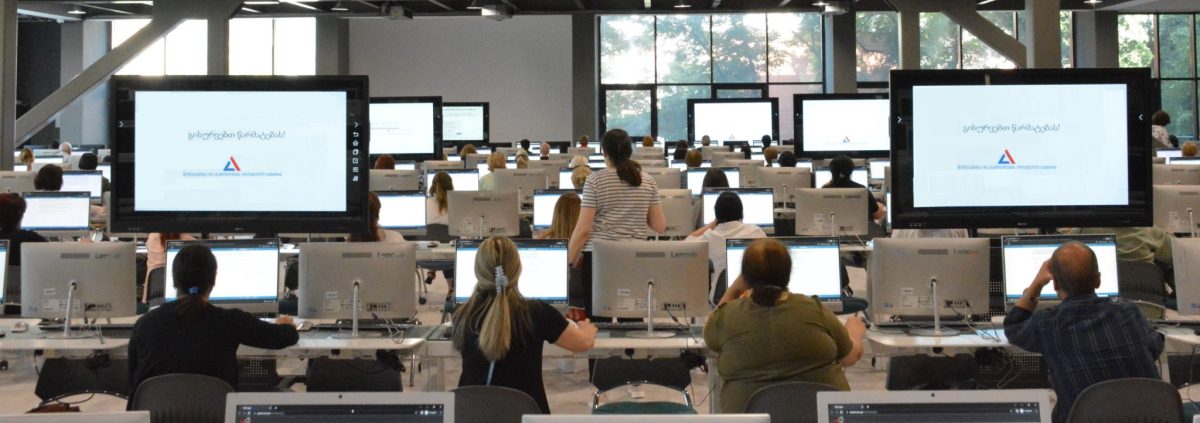
More than 45,000 applicants registered for the Unified National Exams in 2023. In total, for all summer exams, NAEC had to serve more than 75,000 examinees. Creating a comfortable environment for everyone, assigning examinees to the exam centers without prolonging the exams period, delivering results efficiently in the shortest time possible, obviously was not easy; however, like in previous years, the Center managed to cope with these tasks successfully.

Sophia Gorgodze
Director of the National Assessment and
Examinations Center

Photo Credit: Giorgi Ebanoidze

This year’s exam experience also shows that the number of applicants for whom age is no longer an obstacle has increased – higher education can be obtained at any age, if there is a desire for it. In this regard many inspirational stories were brought to our attention. We have watched mothers breastfeeding their babies during short exam breaks, women with children and grandchildren testing their skills in new directions. Such facts bring us joy and admiration, also hope that more and more people will be drawn to self-development and lifelong learning within the upcoming years.

In the 2023 report, we will introduce you to the most memorable exam stories. You will also receive detailed information about the activities that the Center has carried out in various directions throughout the year.
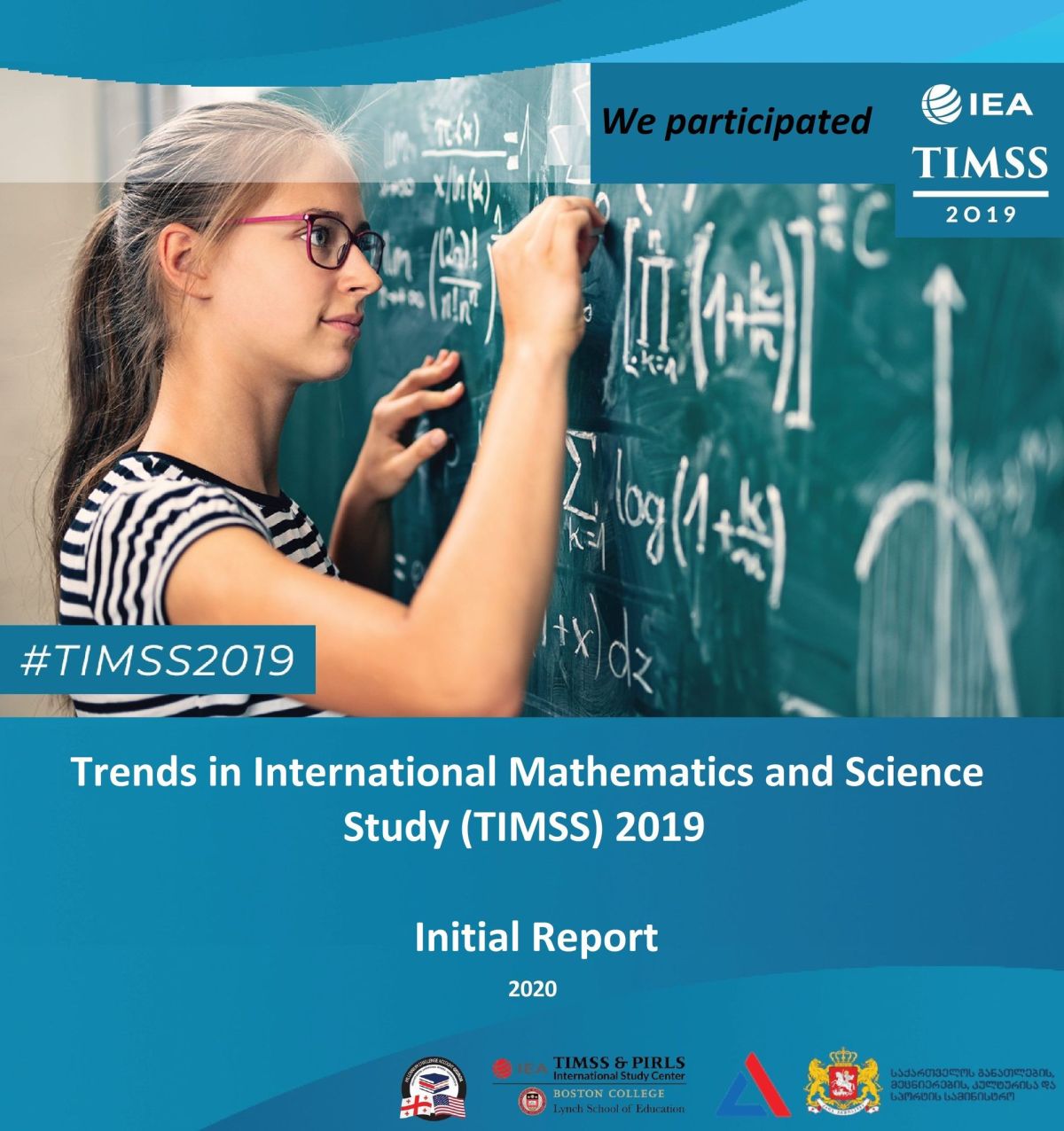
Trends in International Mathematics and Science Study (TIMSS) 2019

The National Assessment and Examinations Center offers the results of Georgia within the framework of an international survey on Trends in International Mathematics and Science Study (TIMSS) 2019.

Conducted every four years since 1995, TIMSS has been a valuable tool for monitoring international trends in mathematics and science achievement at the fourth and eighth grades. Georgia was first involved in 2007 and since then has participated in TIMSS 2011, 2015 and 2019. Georgia was represented by both 4th and 8th grades. The study was administered by the National Assessment and Examinations Center.

Trends in International Mathematics and Science Study (TIMSS) enables participating countries assess their education system, existing teaching practices, and identify obstacles to teaching mathematics and science. The study evaluates the achievement dynamics of the same educational level student compared to previous cycles, and also shows whether student achievement has changed over the years at different stages of learning process in the country (primary and lower secondary).

64 countries participated in TIMSS 2019. 58 countries and 6 regions participated in fourth grade assessment, and 39 countries and 7 regions participated in eighth grade assessment.

From 2019, TIMSS switched to electronic assessment (e-TIMSS). Before stepping towards e-Assessment Georgia conducted a transitional Bridge research. The research fieldwork was conducted from April 24 to May 29, 2019. 226 schools from Tbilisi and different regions of the country participated in the TIMSS 2019 cycle throughout Georgia. A total of 154 fourth (6,002 students) and 145 eighth graders (5,698 students) participated.

Specially designed questionnaires were also completed by school principals, teachers and parents / guardians of fourth graders.

The report can be found here.

The presentation in Georgian can be seen here.

In addition, for the first time, interested parties will have an opportunity to visit the TIMSS website and receive information about the main data of the 2019 survey in Georgian.

Teachers and School Leaders as Valued Professionals (TALIS) 2018 Report, Georgia

The OECD Teaching and Learning International Survey (TALIS) is the largest international survey asking teachers and school leaders about their working conditions and learning environments. It provides a barometer of the profession every five years.

Georgia has been involved in TALIS since 2013. In 2018 Georgia’s participation was made possible through the financial support of Second Compact of Millennium Challenge Corporation (MCC) with Georgia, administered by Millennium Challenge Account – Georgia (MCA-Georgia).

Across all survey components, approximatively 260 000 teachers responded to the survey, representing more than 8 million teachers in 48 participating countries and economies. In Georgia, 3 101 lower secondary teachers and 177 principals completed the TALIS questionnaires.

Based on the voice of teachers and school leaders, TALIS 2018 report offers a series of policy recommendations to help strengthen the professionalisation of teaching careers. The report aims to provide an in-depth analysis of teachers’ and school leaders’ perceptions of the value of their profession, their work-related well-being and stress, and their satisfaction with their working conditions. It also offers a description of teachers’ and school leaders’ contractual arrangements, opportunities to engage in professional tasks such as collaborative teamwork, autonomous decision making, and leadership practices.

Nine main themes were selected for inclusion in the TALIS 2018 survey: teachers’ instructional practices; school leadership; teachers’ professional practices; teacher education and initial preparation; teacher feedback and development; school climate; job satisfaction; teacher human resource issues and stakeholder relations; and teacher self-efficacy. Two cross-cutting themes were added to this list: innovation; and equity and diversity.

A detailed report of TALIS 2018 country-by-country can be found here.